

The recent outbreak of the sal borer raise a larger historical question. When did an inhabitant of the sal forest become a destructive pest? This article explores how changing forest management, commercialisation and climate may have altered the ecological relationship between the sal tree and the beetle.
Vipul Singh
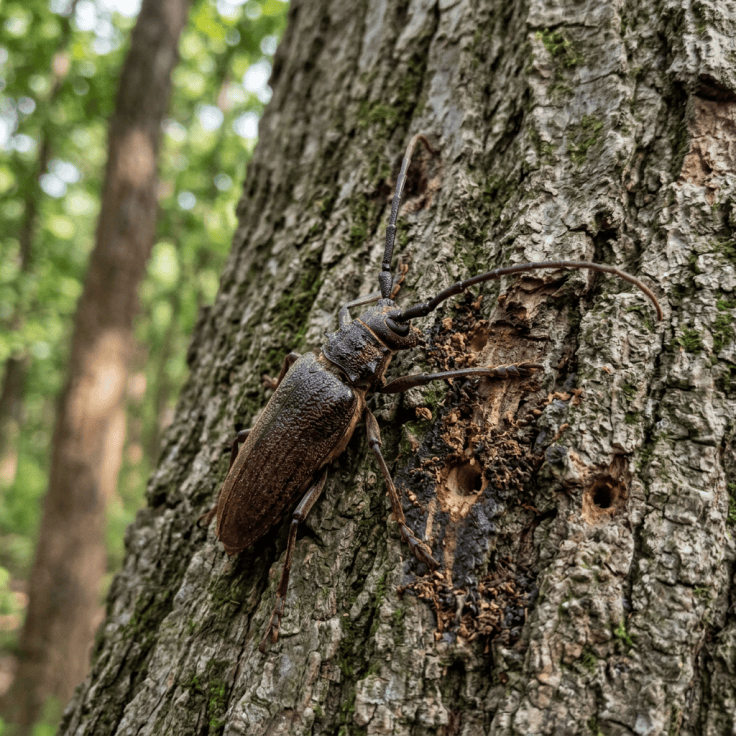
Something unusual is unfolding in the sal forests of Dindori and Mandla in Madhya Pradesh. An entire forest is being mobilised against a beetle. Recent reports in The Indian Express and Down To Earth have drawn attention to the massive pest outbreak. The reports describe a unique campaign in the sal forests of Dindori and Mandla. Villagers are collecting the sal heartwood borer (beetle), Hoplocerambyx spinicornis, by hand and delivering the insects to forest collection centres for ₹2 each. Nearly two million beetles had already been collected when the report appeared, while the Forest Department had begun felling about 1.47 lakh infected sal trees. The operation is being described as one of the largest sal-tree felling exercises in the region in recent years. Felled trap trees are being used to attract adult insects, and thousands of trees are being cut and debarked in an attempt to interrupt the insect’s life cycle.
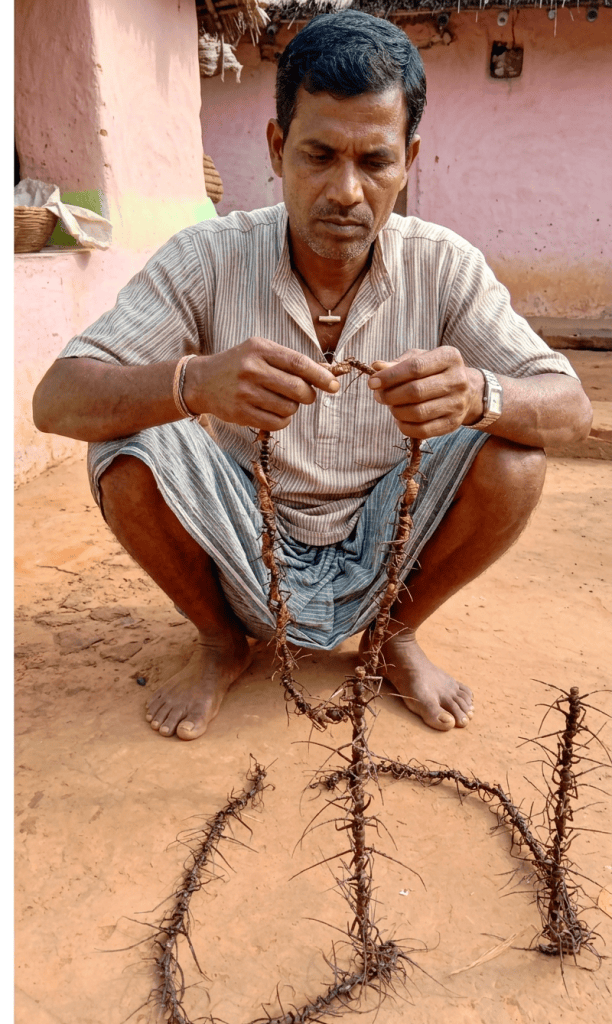
The question arises, why would an insect that has lived with sal trees for a very long time suddenly become such a destructive pest?
The sal borer is not a recently introduced insect, nor is the present outbreak an entirely new phenomenon. It entered the records of Indian forest science in the closing years of the nineteenth century, when Hoplocerambyx spinicornis was first identified as a destructive pest of sal in the Chota Nagpur–Singhbhum region in 1897. A major epidemic was recorded in Balaghat in 1905, suggesting that the insect had already acquired the capacity to move from being an ordinary inhabitant of sal forests to a destructive force within a relatively short period. Thereafter, serious outbreaks were recorded repeatedly across the sal belt in Assam, the Dehradun region, Madhya Pradesh, Bengal, Palamau and other areas. The most destructive early episode occurred in the Mandla-Dindori forests in 1923–24, when an estimated seven million trees were affected. What we are witnessing today, therefore, is not the sudden arrival of a new pest. The history of recurrent sal-borer epidemics stretches back to the very beginnings of modern scientific forestry in India.
One of the questions that intrigues us as history researchers is silence of pre-modern sources about these inhabitant of the sal forest. So, when and how did they come to be defined as a pest?
The scientific history of the sal borer begins in the late nineteenth century. E. P. Stebbing identified it as a destructive pest of sal in Singhbhum in 1897 and published his A Note on the Life History of Hoplocerambyx spinicornis (the Singhbhum Sal-borer) in 1906. The insect was subsequently incorporated into the expanding body of colonial forest entomology. But we should be careful about treating 1897 as the beginning of the sal borer’s history. It was the beginning of its scientific recognition as a forest pest. It was not the beginning of the insect itself.
The sal borer beetle is an indigenous or long-established member of the forest ecosystem, and its larvae normally inhabit sal trees without producing the catastrophic mortality associated with an outbreak. This distinction is important because the late nineteenth century was also the period when the Indian forest itself was undergoing a major transformation in the way it was perceived and managed. The colonial state classified forests according to species, timber value, productivity, regeneration and revenue. Sal, in particular, acquired significant commercial importance because of its strength and resistance to decay. The tree was valued for construction, railway sleepers and other purposes.
A forest that had previously been understood largely through multiple uses such as grazing, fuel, food, resin, hunting, cultivation and timber, was reorganised around the production and regulation of commercially valuable forest resources under the colonial administration. Colonial forestry introduced new systems of classification, measurement and regulation. The important historical change, therefore, was not simply that the British began to cut trees. It was that they sought to reorganise the ecological relations of the forest according to new ideas of property, scientific management and commercial value.
The history of sal resin offers an entry point into this transformation. Sal produces resin, known variously as ral or dhuna, which had long been collected and used locally and commercially. Dhuna was an important forest product in the Jungle Mahals and Singhbhum and entered wider commercial networks. But resin extraction involved girdling the tree. It meant eventually killing it. As the value of sal timber increased, forest officials started calling such extraction as destructive and began regulating it more closely. By the 1870s, the trade in dhuna and other minor forest products had come under much greater control. D. J. Atkinson, in his 1926 Forest Bulletin on Hoplocerambyx spinicornis, made an important observation about ral. He noted that resin appearing on an attacked sal tree was actually a response to the punctures produced by the larvae. In other words, the exudation of resin was a form of natural retaliation by the tree. This indicated that the tree had successfully resisted the insect and was recovering. Resin was thus not merely a protective substance stored inside the tree. It was also part of the tree’s physiological response to injury.
The increasing commercial exploitation of sal altered the frequency and stress experienced by trees. The nineteenth century witnessed the intensification of several kinds of human intervention in sal forests. These included timber extraction, resin collection, changes in fire regimes, restrictions on shifting cultivation, regulation of grazing and the creation of monoculture of sal tree. This possibility becomes significant when we consider the biology of the insect. The sal borer does not attack every tree indiscriminately. It is principally associated with Shorea robusta. Mortality is concentrated particularly among larger trees. Modern accounts note high losses in mature trees, including those in the 121–150 cm girth range.
This creates an ecological paradox. The very characteristics that made sal valuable to forestry – large, mature, healthy-looking timber trees – could also provide the beetle with a large concentration of suitable hosts. If forest management encouraged the retention or concentration of mature sal trees over large contiguous areas, an insect specialised in sal would potentially have a much greater resource base when climatic conditions became favourable.
An interesting similar case is that of Assam tea plantation. Arnab Dey argues that pests should not simply be understood as external enemies attacking an otherwise successful plantation. Tea plantations themselves created ecological conditions that could favour pest multiplication. Shade, rainfall, the structure of the plantation and the movement of people and materials all became part of the ecology of infestation. Thus, plantation could simultaneously be an economic achievement and an ecological vulnerability. Rohan Deb Roy’s work on white ants in colonial South Asia takes this argument further. He has shown that insects were not merely passive objects of colonial science. White ants damaged the paper and wooden infrastructure of the colonial state and thereby influenced administrative practices, scientific knowledge and forms of governmental intervention. Deb Roy calls attention to what he terms ‘entomo-politics’, wherein insects and political institutions shaped one another.
Similarly, once sal became a major commercial timber resource, the borer was no longer merely an insect in the forest. It became an economic threat, an object of scientific investigation and eventually a target of organised state intervention. By the early twentieth century, forest entomology had become an established branch of colonial science. Stebbing was the first Forest Entomologist at the Forest Research Institute, and C. F. C. Beeson later became one of the most important figures in Indian forest entomology. Research increasingly focused on insects that threatened commercially valuable trees, including sal, teak and other economically important species. The Forest Research Institute subsequently developed a large entomological collection and a specialised body of knowledge devoted to identifying, classifying and controlling forest insects. The sal borer became an economic insect. Its importance was measured through timber loss, tree mortality, forest revenue and the cost of control. C. F. C. Beeson devoted considerable attention to the sal borer and to the broader question of the dying-off of sal. His articles, including “Hoplocerambyx and the Dying-off of Sal” and later “The Role of Insects in the Dying-Off of Sal”, appeared in the Indian Forester in the 1920s and 1930s.
Wetter climate in Central India has also acted as trigger. Climatic conditions may have allowed an existing beetle population to cross an ecological threshold. The historical record supports this possibility. Even the present outbreak has been attributed by the local communities to the unusual rainfall that the region experienced over the last two years.
Further Readings:
Atkinson, D. J. Hoplocerambyx spinicornis – An Important Pest of Sal. Forest Bulletin, Government of India, 1926.
Beeson, C. F. C. “Hoplocerambyx and the Dying-off of Sal.” Indian Forester 47, no. 2 (1921); and “The Role of Insects in the Dying-Off of Sal (Shorea robusta).” Indian Forester 60, no. 8 (1934).
Bhagirath, “A War to stop an insect”, Down To Earth, September 2026.
Dey, Arnab. “Bugs in the Garden: Tea Plantations and Environmental Constraints in Eastern India (Assam), 1840–1910.” Environment and History 21, no. 4 (2015): 537-565.
Deb Roy, Rohan. “White Ants, Empire, and Entomo-Politics in South Asia.” The Historical Journal 63, no. 2 (2020): 411-436.
Mohan J, Anand, “Why MP is cutting down 1.4 lakh trees to save them from century-old pest”, The Indian Express, 5 October 2026.
Stebbing, E. P. A Note on the Life History of Hoplocerambyx spinicornis (the Singhbhum Sal-borer). Forest Bulletin No. 8. Calcutta: Government of India, 1906.
Sivaramakrishnan, K. Modern Forests: Statemaking and Environmental Change in Colonial Eastern India. Stanford: Stanford University Press, 1999.
[Total words: 1500]; Reading time: 06 minutes]


Leave a Reply