


Kirātārjunīyam and Kathāsaritsāgara, two Sanskrit literary works from ancient and early medieval India, offer insights into how people imagined, experienced and gave meaning to their natural surroundings. By reading these texts as sources for environmental history, I argue that the history of human-nature relationships must move beyond the material transformation of nature reconstructed through colonial archives.
Vipul Singh
A wild boar emerges from the Himalayan forest while Arjuna is engaged in severe penance to obtain a divine weapon from Śiva. Arjuna shoots at the animal, but so does a hunter standing nearby, a Kirāta, and both claim the kill. What begins as a dispute over the hunted animal soon develops into a fierce combat between the two, in which Arjuna, despite being one of the greatest warriors and archers of his age, finds himself unable to defeat his opponent. It is only after the encounter has tested his strength and skill that Arjuna discovers the hunter’s true identity. He is Śiva himself, who has appeared in the guise of a Kirāta to test the warrior’s worthiness.
This is the main story of Bhāravi’s Kirātārjunīyam, which is a Sanskrit court poem generally dated to the sixth century CE. The story tells us little about the actual extent of Himalayan forests or the abundance of wild boars at the time. But it gives us a glimpse into the cultural world through which people imagined, experienced and gave meaning to nature.
Why should a historian interested in the relationship between society and nature read a poem about Arjuna, who goes hunting? The answer lies in recognising that environmental history need not be confined to the physical transformation of landscapes. It can also investigate how people encountered nature through stories, religious beliefs, literary descriptions and cultural practices.
Beyond the material history of forests
Environmental history has traditionally examined the changing relationship between human societies and the natural world. It has investigated the transformation of forests through agriculture, the extraction of timber, the expansion of plantations, the regulation of rivers, the management of wildlife and the changing ownership of natural resources. Such questions remain fundamental to the field.
But they also raise a problem for historians working on the distant past. The closer we get to the modern period, particularly colonial India, the more abundant certain kinds of documentary evidence become. Forest records, revenue settlements, administrative reports and acts allow historians to investigate how states classified, managed and exploited natural resources. Such records also provide information about changing land use, resource extraction, commercial forestry and the institutional mechanisms through which the relationship between society and nature was regulated.
For earlier periods, this kind of evidence is often less plentiful. Does that mean that the environmental history of the ancient and medieval Indian past must remain largely unwritten? Not necessarily. The problem may lie partly in how we define the subject. If environmental history asks only how much forest existed, who owned it and how it was used, then literary sources will appear of limited value. But if we also ask how forests were imagined, what emotions and beliefs they evoked, and how people understood their place within the natural world, the range of usable historical sources expands considerably.
This is a cultural history of the human encounter with nature. It does not replace the material history of environmental change. Rather, it allows us to investigate a different dimension of the relationship between society and the natural world. Mythological narratives, court poetry, epics, paintings and collections of stories can become historical sources in their own right. They are not transparent records of actual ecological conditions. They reveal the cultural categories, values and assumptions through which particular societies made sense of the natural world.
Bhāravi’s forest: between penance, pleasure and power
In Kirātārjunīyam, the forest is much more than a collection of trees and animals. It is the setting for a transformation in Arjuna’s life. Arjuna enters the Himalayan landscape to perform austerities and obtain a divine weapon in preparation for the coming war. He leaves behind the immediate world of political rivalry and royal responsibilities. The forest becomes a place where a warrior must discipline his body and mind before he can acquire extraordinary power.
Arjuna is already an exceptional archer, but military ability alone is insufficient. He must undergo tapas, or austerities, to become worthy of Śiva’s favour. The forest is, therefore, associated with a form of power that cannot be acquired simply through birth, political authority or martial training. This is a significant cultural meaning of the forest. It provides the setting for a different relationship between human beings and power. In it, bodily discipline, isolation and spiritual aspiration is essential.
Bhāravi in his text also presents the beauty of the mountain landscape, its vegetation, waters, wildlife and sensuous attractions. The forest can invite pleasure as well as discipline. Its natural surroundings are capable of drawing the senses away from the task at hand. At the same time, it also provides the setting for spiritual achievement.
The encounter with the wild boar brings another dimension into the story. Arjuna’s relationship with the forest is suddenly transformed from one of ascetic withdrawal to one of hunting and combat. The animal becomes central to a dispute over skill, honour and the right to claim victory. The hunter complicates Arjuna’s understanding of the landscape. Arjuna enters the forest as a prince and warrior pursuing a specific goal. The Kirāta appears as a hunter who belongs to a different imaginative world. The apparent difference between them becomes especially significant when the hunter is revealed to be Śiva.
The divine has appeared in a form that Arjuna does not initially recognise. The encounter unsettles ordinary distinctions between the familiar and unfamiliar, the human and divine, and the apparently humble and supremely powerful. For an environmental historian, the episode is valuable not because it records an actual hunting expedition, but because it connects the forest with spiritual discipline, animal life, martial prowess and divine revelation. The same landscape acquires different meanings according to the person who enters it and the purpose that brings them there.
A different forest in Somadeva’s Kathāsaritsāgara
Written in Kashmir around the eleventh century, Somadeva’s Kathāsaritsāgara, or Ocean of the Streams of Story, is another rich material on forests. It contains tales of kings, merchants, ascetics, hunters, supernatural beings and extraordinary journeys. Its literary world differs from that of Bhāravi’s Kirātārjunīyam, which concentrates on a heroic encounter in the forest. The Kathāsaritsāgara moves between stories, settings and characters, and presents a world in which forests are places of adventure, danger, pleasure, political strategy and unexpected encounters.
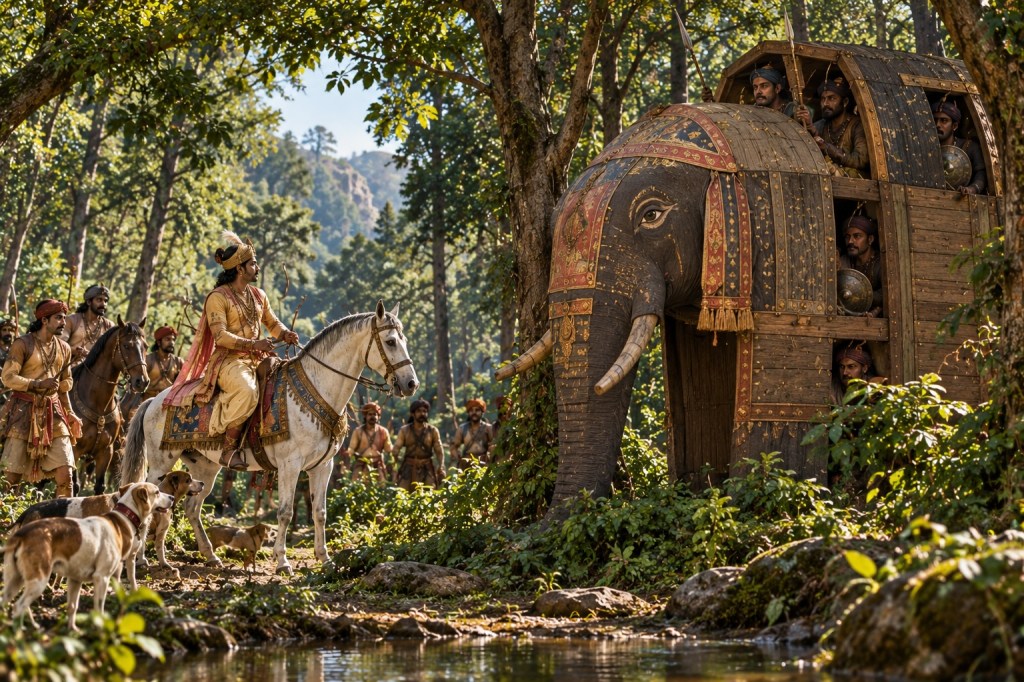
Udayana is famous for his mastery of the lute and his ability to attract and tame wild elephants through music. He spends much of his time hunting and capturing elephants in the forest. His passion for the chase, however, becomes a political vulnerability. The king of Ujjayinī, Chandamahāsena, wishes to bring Udayana under his control. Knowing his fondness for capturing wild elephants, he arranges a stratagem involving an artificial elephant placed in the Vindhya forest. Udayana approaches the apparent animal, only to be trapped by the armed men concealed within it and taken to Ujjayinī.
The forest in this story is not primarily a place of spiritual withdrawal. It is a landscape of royal recreation, animal capture and political intrigue. Udayana’s relationship with the forest is shaped by his status as a king, his interest in hunting and his remarkable ability to tame elephants.
The episode also brings animals into the world of human power. Wild elephants are not merely part of the landscape. They are objects of fascination, skill and royal ambition. The ability to capture and tame them distinguishes Udayana, while his attachment to the chase allows another ruler to manipulate him. The forest becomes a place where the natural world and political strategy intersect. What appears to be an ordinary hunting expedition turns into an episode that changes the course of a king’s life.
Read alongside Bhāravi, this story suggests that the forest could be imagined in more than one way. In Kirātārjunīyam, it is the setting for spiritual discipline and a divine test. In the Udayana narrative, it is a space of royal hunting, animal capture and political deception. These are not necessarily competing understandings of nature. They reveal the plurality of meanings attached to forest landscapes in different narrative settings.
When hunting becomes dangerous: the story of Pāṇḍu
The Kathāsaritsāgara offers another perspective through the story of Pāṇḍu, which Nārada recounts while warning a king about the dangers of hunting. Pāṇḍu, the ancestor of the Pāṇḍavas in the Mahābhārata, goes hunting in the forest and shoots a deer. He discovers too late that the animal is a sage, Arindama, who has assumed the form of a deer while sporting with his wife. Before dying, the sage curses Pāṇḍu. He too will die if he approaches his wife sexually. The curse eventually leads to Pāṇḍu’s death. Nārada uses this story to caution against the dangers of royal hunting. The chase, which kings might regard as recreation or an assertion of prowess, can bring unforeseen consequences.
This narrative introduces a moral dimension absent from a simple celebration of hunting skill. The forest is a place where the hunter cannot always distinguish what he sees. An apparently ordinary animal may conceal a human or sacred identity. The act of killing may therefore carry consequences that extend far beyond the immediate encounter.
The story also invites us to consider the limits of royal power. A king may command armies and exercise authority over his subjects, but the forest is not a world in which every encounter can be controlled or fully understood. Here, the cultural meaning of hunting becomes more complex. It can demonstrate skill and status, as in Udayana’s pursuit of elephants, but it can also reveal the dangers of careless violence and the limits of human knowledge. The forest is thus neither simply benevolent nor inherently threatening. Its significance lies in the encounters that take place within it and the meanings that authors attach to them.
What can these stories tell us about environmental history?
Taken together, the two works suggest several possibilities for writing the cultural history of nature in ancient and early medieval India. First, forests were not assigned a single meaning. They could be places of austerity, beauty, hunting, political ambition, danger or divine revelation. These meanings could overlap within the same narrative, and they varied according to the characters and purposes involved.
Second, relationships with nature were represented as socially differentiated. The king, warrior, ascetic and hunter did not necessarily encounter the forest in the same way. Their identities shaped what they sought, what they noticed and what the forest meant to them.
Third, animals could occupy positions that went beyond their material uses. The boar in Bhāravi’s poem becomes the starting point for a divine test. The elephant in Somadeva’s narrative becomes an object of royal fascination and political strategy. The deer in Pāṇḍu’s story becomes the vehicle through which the consequences of careless hunting are revealed.
These narratives, therefore, provide evidence of the cultural and moral worlds through which human relationships with animals and forests were understood. They also encourage us to ask what lies beyond the stories. Whose experiences are being represented? The texts largely foreground kings, warriors, ascetics and other exceptional figures. The everyday activities of woodcutters, pastoralists, cultivators and forest-dwelling communities receive far less attention. Their absence is itself an important reminder of the social limits of literary representation.
Reading literature as historical evidence
None of this means that literary descriptions can be used as direct evidence of ecological conditions. A poetic account of a dense forest cannot establish the extent of forest cover. A story about elephant capture cannot tell us how widespread the practice was. Nor can a mythological hunter automatically be identified with a historical forest community.
As history researchers we must try to distinguish between what a text represents and what can be established about the material world. Literary conventions, religious ideas and narrative requirements all shape the stories we read. But this qualification should not lead us to dismiss literature as an environmental-historical source. It should instead encourage us to ask more precise questions. Why does the author choose a forest rather than a court or a battlefield for a particular encounter? Why does a hunter become the form through which Śiva tests Arjuna? Why does a king’s passion for hunting become a means of political manipulation? Why does the killing of a deer lead to a curse? Such questions reveal the meanings attached to nature and the assumptions that made particular narratives compelling to their audiences.
Literature can also be read alongside inscriptions, land grants, religious texts, legal traditions and other historical evidence. These sources do different kinds of work. Inscriptions and administrative records may illuminate institutions, rights and material transactions. Literary narratives reveal the imaginative and moral worlds within which nature was understood. The two need not be treated as separate histories. They can be brought into conversation, provided we remain attentive to the different kinds of evidence they offer.
The forest beyond the archive
Environmental history need not be confined to the material transformation of nature. It can also explore the cultural meanings through which people encountered, understood and represented the natural world. This approach opens up new possibilities for writing the environmental history of the pre-colonial past, in which the kinds of systematic records available for the colonial period are relatively scarce. The absence of detailed data on forest cover, resource extraction or changes in land use need not, therefore, imply an absence of environmental history.
It does, however, require us to ask a different set of questions. Rather than concentrating exclusively on how much forest existed, who controlled it, how it was used or how its resources were transformed, we can investigate what forests meant to different groups of people, how they were represented in literary and religious traditions, and what kinds of relationships between humans and the non-human world these representations made possible. Why did forests become settings for ascetic practices, hunting expeditions and encounters with the divine? How were animals represented as objects of royal power, participants in sacred encounters, or beings whose killing could have moral consequences? What distinctions did literary traditions draw between the forest and the settled world, and how did these distinctions shape the cultural imagination of nature?
Texts such as Bhāravi’s Kirātārjunīyam and Somadeva’s Kathāsaritsāgara allow us to pursue these questions by treating literary narratives not as direct records of ecological conditions, but as evidence of the cultural worlds in which particular understandings of nature acquired meaning. Read alongside inscriptions, land grants, religious treatises and other historical sources, they can help us reconstruct dimensions of the human–environment relationship that administrative and economic records alone cannot adequately capture. Such an approach does not replace the material history of environmental change; it broadens the field by bringing cultural perceptions, religious beliefs, literary representations and moral understandings of nature into the historical analysis.
These texts suggest that environmental history is not only the material transformation of nature but also the cultural meanings through which people encountered it. Writing the environmental history of the pre-colonial past requires us to move beyond the assumption that history becomes possible only when systematic quantitative data or detailed administrative records are available. It calls for different questions, a wider range of sources and a critical reading of the ways in which nature was imagined and represented. The hero of the text, who went hunting in the Himalayan forest thus offers more than a memorable literary episode. He reminds us that the history of human engagement with nature is also a history of the meanings people attached to the natural world.
Further Readings:
1. Bhāravi. Arjuna and the Hunter: The Kirātārjunīya of Bhāravi. Edited and translated by Indira Viswanathan Peterson. Cambridge, MA: Harvard University Press, 2016.
2. Peterson, Indira Viswanathan. Design and Rhetoric in a Sanskrit Court Epic: The Kirātārjunīya of Bhāravi. Albany: State University of New York Press, 2003.
3. Rangarajan, Mahesh, and K. Sivaramakrishnan, eds. India’s Environmental History: From Ancient Times to the Colonial Period. Vol. 1. Ranikhet: Permanent Black, 2012.
4. Somadeva. The Kathā Sarit Sāgara, or Ocean of the Streams of Story. Translated by C. H. Tawney. 2 vols. Calcutta: J. W. Thomas, 1880–84.
5. Thapar, Romila. “Perceiving the Forest: Early India.” Studies in History 17, no. 1 (2001): 1–16.
[Total words: 2600]


Leave a Reply