Public history brings the past into everyday life. It shows how history is made and understood beyond classrooms and archives, in cafe, on streets, in monuments, through YouTube podcast, through memory, heritage walk and in public debate. Image: Heritage Walk at Chittorgarh Fort What Is Public History? Public history is an approach to the past... Continue Reading →
A Tribute to DU’s Bhelpuriwala
Mr Sunil Sethi wasn’t just a Bhelpuriwala. He was in many ways the heart of DU's North Campus. His cart had seen it all: new friends, breakups, breakdowns, revolutions, and reconciliations. Mr Sunil Sethi engrossed in Bhelpuri making Last Monday, Delhi woke up to its usual cocktail of smog and despair, with an AQI so... Continue Reading →
Stepwells as Climate Change Adaptation Strategy in Early Medieval India
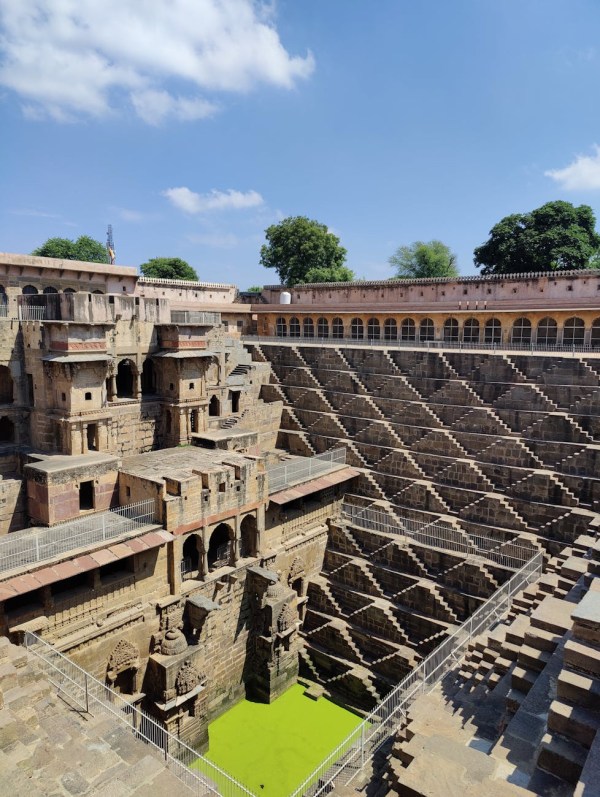
Stepwells are early medieval, multi-tiered water storage structures built to conserve rainwater in the arid regions of Rajasthan, Gujarat, and Delhi, functioning as both reservoirs and cool community spaces. Their architectural brilliance showcases early ingenuity in climate adaptation and sustainable water management.
Indus Water Treaty: Unraveling the Kashmir Conflict’s Hydro-Politics
India and Pakistan have abided by the 1960 Indus Water Treaty thus far. The roots of the Kashmir dispute are embedded in this water agreement. Until now, India has focused on resolving the Kashmir issue as a political matter. However, there may come a time when India will recognise the need to address the Kashmir... Continue Reading →
Visualising the Geographical Sphere of India
Vipul Singh Understanding of India's geographical boundaries cannot be solely attributed to British cartographic tradition. Instead, it is a product of various historical, political and cultural factors that have shaped the concept of India as a unified entity. It is often said that India that we know today in geographical terms with fixed boundaries is... Continue Reading →
The Columbian Exchange
Vipul Singh 1492 marked a transformative shift in global interactions between humans and nature. With Columbus’s voyage and subsequent explorations, a new era of contact and biological exchange commenced on a global scale, forever altering the trajectories of both ecosystems. It triggered an ecological revolution of unprecedented magnitude, characterised by its rapidity, magnitude, and far-reaching... Continue Reading →
ANTHROPOCENE: THE ZEITGEIST OF THE TWENTY FIRST CENTURY
Vipul Singh Anthropocene proposes that humans play an active role in shaping and altering the Earth. Recently, Subcommission on Quaternary Stratigraphy has voted against the proposal to give Anthropocene a formal recognition. Despite this, Anthropocene is likely to remain important in discussions related to human influence on the planet. NASA Space Telescopes See Weather Patterns... Continue Reading →
History, Environmental History and Global Environmental History
Vipul Singh https://youtu.be/uGKs-iYLPI0?si=_j8qAnJJ7lFDk-bq Historians, in general, stress the need for in-depth examination of specific regions and localities to write historical narratives. They study a wide range of topics related to human societies, including political history, social history, economic history, cultural history, and intellectual history. Among the practitioners of history, there is often an emphasis on... Continue Reading →
The “Wagh Nakh” Dagger: Unveiling the Intricacies of a Historical Relic
Vipul Singh The Wagh Nakh dagger, designed like tiger claws, embodies Maharashtra's valour. Its return from British authorities rekindles its historical significance, tied to Chhatrapati Shivaji Maharaj's 1659 encounter with Afzal Khan. This relic transcends an era of political intrigue and martial courage, with a design reflecting both symbolism and functionality. Tracing its ownership adds... Continue Reading →