

Vipul Singh
The Wagh Nakh dagger, designed like tiger claws, embodies Maharashtra’s valour. Its return from British authorities rekindles its historical significance, tied to Chhatrapati Shivaji Maharaj’s 1659 encounter with Afzal Khan. This relic transcends an era of political intrigue and martial courage, with a design reflecting both symbolism and functionality. Tracing its ownership adds layers to its compelling history.
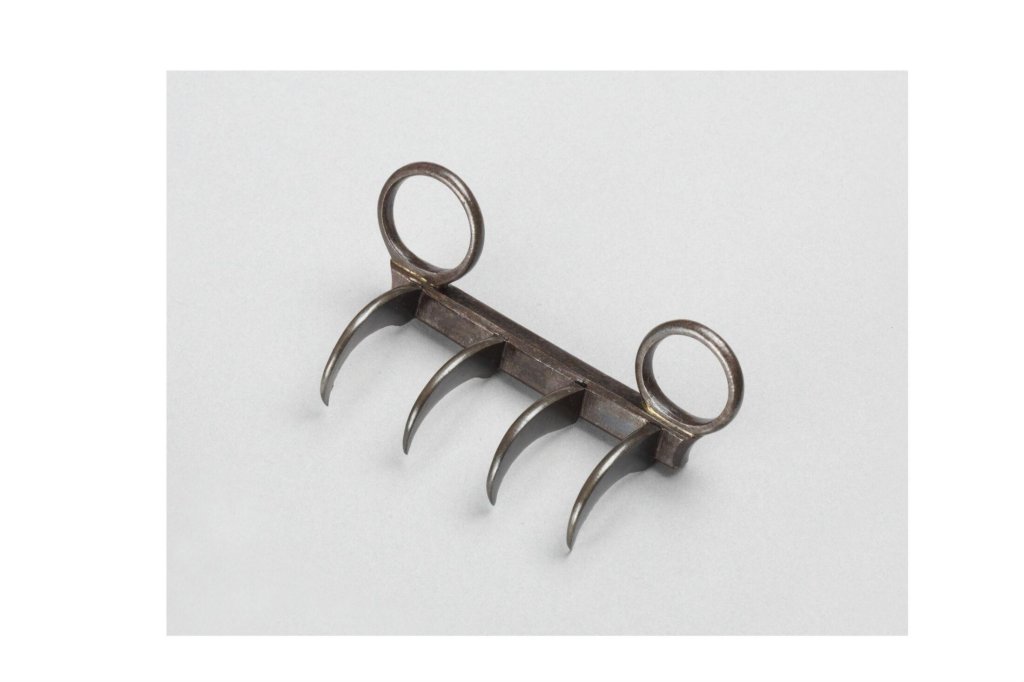
In the annals of history, few artifacts possess the power to encapsulate the essence of a region’s valour and heritage quite like the Wagh Nakh, a dagger designed in the image of a tiger’s claws. Recent return of this extraordinary weapon from British authorities has thrust the Wagh Nakh into the spotlight, highlighting its profound historical significance.
Central to its historical narrative is its association with the legendary Chhatrapati Shivaji Maharaj and his momentous encounter with Afzal Khan in the year 1659. This relic, far more than a mere physical object, serves as a tangible link to an era marked by political intrigue and unwavering martial courage.
The Wagh Nakh is a remarkable testament to the ingenuity of weapon design. This exceptional dagger possesses a construction that is nothing short of intricate and ingenious. It is characterized by the presence of four curved blades that are firmly affixed to a crossbar or glove. This design meticulously mirrors both the ferocity and grace of a tiger’s claws, paying homage to the symbolic prowess of these formidable creatures in the natural world. What sets the Wagh Nakh apart is not only its distinctive form but also its practicality. Crafted with great thought and precision, it was designed to be concealed under the palm of its wielder, with two rings that fit snugly over two fingers. This design feature not only allowed for discreet carrying but also provided stability when the weapon was in use.
Tracing the ownership of the Wagh Nakh unveils a captivating historical odyssey. Originally possessed by James Grant Duff, an officer of the East India Company and the Resident of the Satara State in 1818, the dagger changed hands following the defeat of the Marathas in the Third Anglo-Maratha War. It was during this period that Baji Rao II, the last Peshwa of the Marathas, surrendered to the British and possibly presented the Wagh Nakh to James Grant Duff.
Historical Context
The fame of the Wagh Nakh is intrinsically linked to a pivotal showdown that transpired in 1659 between Chhatrapati Shivaji Maharaj and Afzal Khan, a formidable general in the service of the Bijapur Sultanate. The encounter between Shivaji and Afzal Khan existed within a multifaceted political, social, and economic landscape. While contemporary accounts often emphasize religious and mythological aspects, it is vital to recognize the profound political undercurrents at play. This backdrop included the ambitions of the mighty Mughal Empire, internal divisions within the Bijapur Sultanate, and broader regional power struggles. Bijapur’s involvement in the campaign against Shivaji was significantly influenced by Mughal interests in the Deccan region. Emperor Aurangzeb’s explicit goal of annexing Bijapur compelled a response, and Shivaji’s activities in the Konkan region were perceived as a substantial threat.
Afzal Khan’s letter to Shivaji serves as a cryptic prelude to their meeting. In it, Afzal Khan addresses territorial disputes: “The territory, which after the disappearance of the Nizam Shah had been taken by Adil Shah, and which had been given by him to the Mughals in the interest of peace, that territory full of hill-forts, has been taken and appropriated by you.” This letter hints at longstanding grievances and suggests the complex web of regional politics that framed this encounter.
Shivaji’s response, carefully worded and laced with subterfuge, showcases his political acumen: “I have nothing but contempt for the army of the haughty Mughals, also for that of Adil Shah, excepting you of terrible power. Come along and be comfortable in the journey. I shall give up the forts, and as you ask for it, this Jawali also.” In this letter, Shivaji employs diplomatic language to mask his true intentions, revealing his ability to navigate treacherous waters.
Nurullah, a nobleman at Adil Shah’s court, offers a contemporary account from the Bijapur perspective: “Ali Adil Shah, on seeing that the prevalence of the Mohammedan religion was not possible unless the bramble of infidelity was burnt up in the fire of the enemy-consuming sword, appointed Afzal Khan with ten thousand horsemen to chastise and extirpate that wicked man Shivaji.” Nurullah’s account reflects the Bijapur Sultanate’s perception of Shivaji’s actions as a threat to their faith.
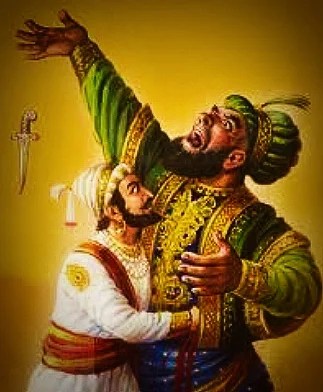
Kavindra Paramanand’s Shiva Bharat provides a Maratha perspective, offering insights into the dramatic encounter itself: “So saying, he held his neck with the left hand and with the other, struck him in the side with a dagger. An expert wrestler, Shivaji quickly got his own neck released, and keeping his head cool and slightly contracting his body, avoided the dagger as it entered his side. Shivaji immediately thrust his dagger deep into Afzal Khan.”
Before the historic rendezvous between Chhatrapati Shivaji and Afzal Khan took place at a neutral location in 1659, Afzal Khan attempted to coerce Shivaji into submission, but treachery lurked in the shadows. Shivaji’s remarkable presence of mind and unwavering self-confidence foiled Afzal Khan’s attack. In the ensuing chaos, both Afzal Khan and his retinue met their fates.The confrontation between Chhatrapati Shivaji Maharaj and Afzal Khan in 1659 created an indelible mark on the canvas of Indian history. This clash of titans, shrouded in intrigue and political maneuvering, possesses enduring significance.
The primary sources and historical letters unravel the intricacies of this pivotal event. They provide insight into the complexities of the political landscape and the diplomatic finesse exhibited by its two central figures. These accounts enable us to peel back the layers of history and perceive the past through the eyes of those who experienced it, illuminating the lasting legacy of this historic showdown.
Shivaji, renowned for his strategic brilliance and martial prowess, recognised the value of a weapon like Wagh Nakh. Its concealed nature made it a formidable tool for self-defence and offence, particularly during dramatic encounters. The design of the Wagh Nakh, with its homage to the tiger’s claws and its practical concealment, serves as a testament to the artistry of weaponry in history. It embodies a fusion of symbolism, function, and craftsmanship that continues to captivate the imagination of historians, enthusiasts, and admirers of this unique historical relic.


Leave a Reply