

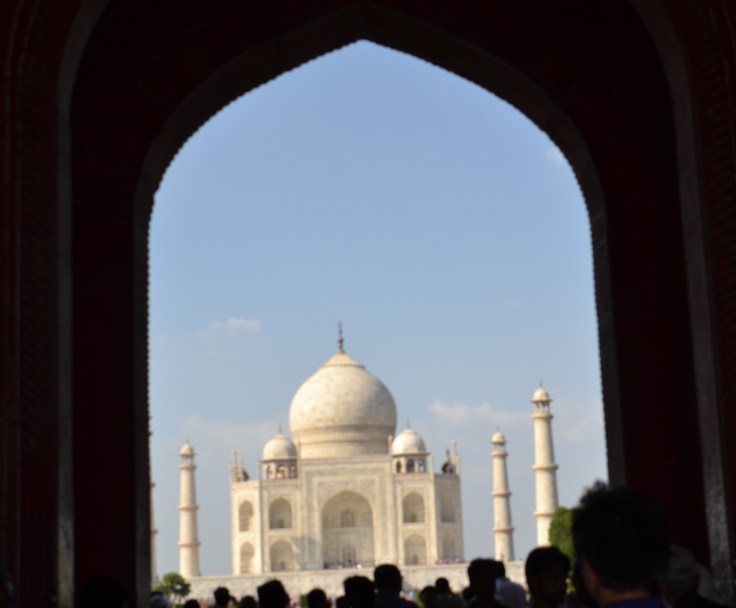
Photo by Vipul Singh
Climate Crisis and the Making of Early Modern Monuments
Vipul Singh / Speakinghistory / November 2019 / 5 minutes (1040 words)
ABSTRACT: When variation in rainfall and intensity of droughts became very high in the seventeenth century Shahjahan used state’s treasury for grand projects to give employment to suffering cultivators during drought years so that they survive and come back to plantation again when life would return to normal.
India has witnessed many monsoon failures, delayed monsoon, unseasonal rains, and torrential rains in formerly drier regions in recent few years. There are also occurrences of deluge in riverine landscapes and flood in cities due to heavy downpour. These unpredictable weather events have been linked to global warming and resultant climate change by the climate scientists. India is not the only country where climatic crisis is being experienced. It is happening in different parts of the world.
The world witnessed a similar climatic crisis even in the sixteenth and seventeenth centuries. The only difference was that it was not human induced. It was the result of the change in global temperature due to natural reasons. What did the states do in historical past to tackle these challenges in those testing times of economic slowdown and loss of livelihood? If we could learn from history there are many materials for wisdom.
Big monuments and structures in early modern India were often undertaken as projects to provide employment. These projects were initiated at a time when people faced a lot of crisis due to the droughts and the consequent famine. For centuries elaborate systems of grain stores, public works and famine relief measures had been developed by the Indian rulers to dull the cruelest effect of drought. We have examples in historical records which suggest that the rulers took initiatives to supply grains and set up soup kitchen. This was done to serve free food to the cultivators of drought affected regions. In the wake of the recurring droughts in the seventeenth century emperors like Shah Jahan undertook the task of building big monuments and structures. It sounds as contradiction in terms, but practically the policy worked wonders. The building projects worked as shock absorber to the climatic crisis that had led to scarcity of food.
Little Ice Age that came in the seventeenth century is a historically proven fact. Between 1550 and 1715 the scientists observed that there were almost lesser solar sunspot activities. In fact, between 1645 and 1715 there was almost no sunspot activity. This phenomenon of no solar sunspot is referred to as Maunder Minimum. In global terms low sunspot meant that Sun would not be releasing the amount of heat it normally released to keep the earth warm. These years were climatically worst years. It was marked by lengthening of winter and slight decline in summer temperature. This led to massive crop failures in Europe.
In South Asian counties like India the temperatures did not come down to level of the European countries. But there was certainly variation in rainfall patterns due to no sunspot activity. Indian agriculture in particular was highly dependent on monsoon rains. The variation in rainfall pattern brought havoc for the cultivators. There were unprecedented droughts during 1550-1715. The intensity of droughts became very high in seventeenth century. There were horrific years of drought between 1595-98. There was another episode of drought year in 1613-15 resulting in severe famine. It was followed by bubonic plague that lasted for eight years, and there were many deaths. This has been recorded by the then Mughal ruler Jahangir in his memoir. The second major drought came during Shah Jahan’s rule in 1631-32 in eastern India and in 1632-34 in Gujarat and Deccan. The implication of the resultant famine has been mentioned by Peter Mundy, the British merchant who had visited India at that time, and also by Shah Jahan’s chronicler Abdul Hamid Lahori.
Learning from the past experiences, Shah Jahan started the construction of the Taj Mahal in 1632 that continued for 22 years. It employed roughly 22,000 artisans and workers. He also got Moti Masjid (1648-54), Jama Masjid in Delhi (1650-56), and many more monuments one after another to blunt the effect of recurring droughts. His rebel son Aurangzeb too had to face a terrible drought in 1662-65. But Shah Jahan’s grand projects had gradually emptied the treasury of the Mughal empire. Aurangzeb, therefore, was not in a position to undertake such projects. He, on the contrary, decided to undertake expeditions to bring in more revenue to the state treasury. Conflicts ensued on different fronts, and that ate up much of his revenue resources. As a result, there was a reversal of the Mughal empire’s fortunes immediately in the next century. This happened because of the dramatic shift in the policy of the state in situations of reduced agricultural production. Aurangzeb’s conflict with the Marathas and revolts of the Jats and Satnamis did play a role in Mughal empire’s decline. But the underlying driver could have been crop failures that led to economic slowdown which aggravated unrest and conflicts all around.
It is pertinent to look at policies followed by the two Mughal rulers- Shah Jahan and Aurangzeb- in similar circumstances. On the one hand we have the example of Shah Jahan who tried to avoid conflicts and used state’s treasury for grand projects so as to give employment to suffering cultivators during drought years. This, so that these toiling cultivators could survive and come back to plantation again when life would return to normal. Aurangzeb, on the other hand, went into an extractive mode who decided to replenish state’s treasury through expeditions and jizyah. This proved to be the turning point for the Mughal rule as it led to the alienation of the Hindus. The Rajputs and the Marathas became staunch enemies of the Mughal ruler. Aurangzeb perhaps did not understand Abul Fazl’s warning that benefits of jizyah were imaginary and tended to promote dissensions among subjects. Any policy that created dissension was bound to lead to further problems for the state.
The idea of initiating big projects is relevant even in today’s time when the country is facing economic slowdown. The construction of highways, railway networks, metro line projects, and the monuments could work as magic for the tottering economy. While the networks of communication provide employment to huge unskilled workforce, the monuments such as Sardar Patel’s statue promote tourism. Tourists’ visit help in redistribution wealth to the rural poor and create employability in the region. Such projects are essential to keep the money in circulation and provide boost to the sluggish economy.
Copyright:Vipul Singh
 Speaking History
Reblogged this on PastMatters and commented:
Idea of initiating big projects is relevant even in today’s time when the country is facing economic slowdown. The construction of highways, railway networks, metro line projects, and the monuments could work as magic for the tottering economy.
LikeLike