

Vipul Singh
Does ecology or the physical character of a region play any role in the construction of political space? The story of the creation of Bihar province in the sixteenth century in the riverine ecology of the mid-Ganga basin helps us to understand the connection.

In 1541, Sher Shah came to Patna on his return from the campaigns in Bengal. Like many other observers, he was also attracted to the beauty of the banks of the Ganga. He was very impressed by the location of Patna. While he stood on the bank of the Ganga, he expressed his appreciation in these words – ‘…if a fort were to be built in this place, the waters of the Ganga could never flow far from it, and Patna would become one of the great towns of this country. The actual reason was more associated with the locational advantage of the city.’ Two decades later, when Akbar campaigned in Patna, he also camped on the banks of the river, because it was safe and also serene. The sixteenth-century text Ain-i Akbarimentions how Akbar was overwhelmed by the mid-Ganga character. He praised the Ganga for the purity of its water and the beauty of the surrounding. Very soon, Akbar declared Bihar as a separate suba (province) of the Mughal empire. Between 1574 and 1576, Akbar was able to bring Bihar under the control of the Mughal Empire. In 1580, he undertook the administrative reorganization of the empire and Bihar was declared a separate suba.
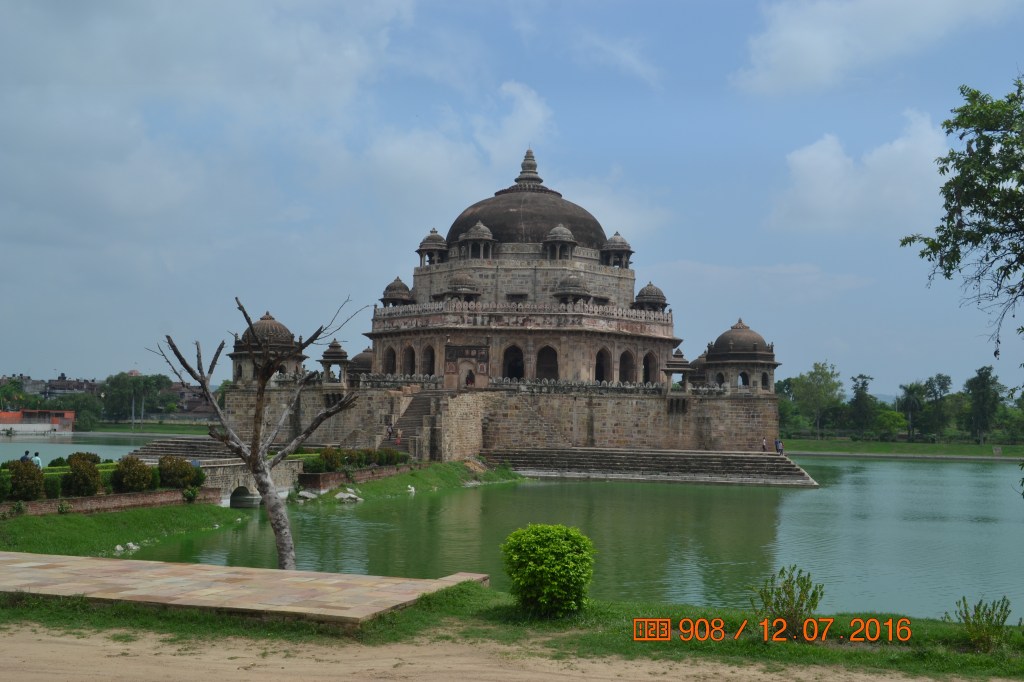
The history of conflicts in this region suggests that different rulers attempted to take control of the mid-Ganga plain, but it could not be brought under the control of a single authority. Minhaj Juzjani in his Tabqāt-i-Nasiri mentions that when Bakhtiyar Khalji was trying to carve out his own principality in Bengal, ‘Tirhut’ (north Bihar) and ‘Bihar’ (south Bihar) were two separate political regions in the first half of the thirteenth century. The earliest attempt to bring the entire mid-Ganga region under control was under Ghiyasuddin Tughlaq in 1324. This he could do for a very limited period of time and it excluded a major part of north Bihar. The fourteenth-century chronicler Isami has given a detailed description of Ghiyasuddin’s conquest of Tirhut after his return from Bengal. The inscription at the Jami mosque built in Darbhanga by the Tughlaqs is evidence of the Tughlaq control of north Bihar for a short duration. Ziauddin Barani also mentions Bihar as part of the administrative province of Muhammad-bin-Tughlaq’s Empire. Very soon, however, the area went under the control of the Sharqi kingdom of Jaunpur. It was only under Sikander Lodi in the early sixteenth century that western part of Bihar was snatched away from the Sharqis. Sikander Lodi gave the charge of this territory to Dariya Khan Nuhani.
The Nuhani Afghans declared their independence from the Lodis. They were able to bring in a major part of north Bihar into their rulership. Sher Khan used this base of the Nuhani political authority to build up the Afghan empire in this mid-Ganga region.
Sher Khan had grown up in Shahabad and so fully realized the potential of the region. He was quite successful in controlling the region. He not only understood the river ecology of the mid-Ganga region but also used the river courses to imagine a political region. A similar river ecology along with a homogenous culture acted as a marker for him. Under him, the first seed of Bihar as a suba was sown.
For Sher Shah Bihar worked as the ‘political and military nursery’. Before the foundation of the Sur dynasty under him, different smaller Hindu chieftains ruled the territory. The Sharqis of Jaunpur controlled the territory adjacent to eastern Uttar Pradesh. In the last decade of the fifteenth century, Sikander Lodi, who ruled from Delhi, ravaged the entire mid- Ganga region, including Jaunpur and Bihar, making the region fluid. It was after this that many smaller Afghan chiefs got jagirs (revenue collection land-holding rights) in Bihar. Sher Khan, initially, was just one among many Afghan chiefs who had inherited the jagir of his father at Sasaram. Gradually, he united the different Afghan chiefs and laid the foundation of Afghan rule in the mid-Ganga basin, stretching from the areas of eastern Uttar Pradesh up to Munger in the east and Sasaram in the south. Abbas Sarwani has given the details of the land revenue administration initiated by Sher Khan, which was in sync with the local environment. He was particularly concerned with the suffering of the cultivators. He not only gave them ‘right to choose the mode of payment’ but also warned the muqaddams and zamindars, as in charge of revenue collection, against the oppression of the cultivators.
As the Sur rule expanded up to Delhi, Bihar was made a separate province with Patna as its capital. For the first time, we get references to the territorial demarcation of Bihar in any historical account. Sher Shah conceived the idea of an administrative Bihar as it corresponded with the ecology of riverine Bihar. Taikh-i-Daudi mentions that before the battle Battle of Chausa (1539) with the Mughal ruler Humayun, who wished to bring the entire eastern region under his control, Sher Shah initially offered to surrender the mid-Ganga region of Bihar and retain Bengal for himself. Sher Shah categorically identified that the area that he was referring to meant Bihar province. The area beyond the Karmnasa river in the west up to Garhi in the east (bordering Bengal) was declared as ‘Bihar’. The negotiations between Sher Shah and Humayun did not work out and they went to war. War took place between the two, but what comes out clearly from these accounts is that the idea of Bihar as a region was already conceived.
After the death of Sher Shah, with the gradual weakening of control over Bihar, Akbar took control over the region. The accounts of the late sixteenth century mention Garhi as the easternmost boundary of Bihar. Abul Fazl has described the boundary of the suba as follows- —‘Its length from Garhi to Rohtas is 120 kos; its breadth from Tirhut to northern mountains, 110 kos. On its eastern boundary is Bengal; to the west lie Allahabad and Oudh. On the north and south, it is bounded by hills of considerable elevation.’ To facilitate the administration of the region from Agra, Akbar gave some degree of relative autonomy by creating a province or suba of Bihar and appointing a governor.
Bihar province had seven sarkars (districts) within it – Bihar, Munger, Champaran, Saran, Rohtas, Hajipur, and Tirhut. Rivers were used as the boundaries in the creation of all seven sarkars. Sarkar Bihar (Patna-Gaya) was spread over the fertile plain south of the Ganga. Sarkar Munger was also spread across the right bank of the Ganga but to the east of Bihar. Sarkar Champaran was situated along the right bank of the Gandak river. Sarkar Saran was situated between the rivers Ghaggar and Gandak. The Gogra and Ganga mark the southwestern of Saran and separate it from Ballia. The Jharhi river separates it from Gorakhpur in the northwest. Sarkar Rohtas was spread between the Ganga and the Son river. Sarkar Hajipur was a narrow strip between the Burhi Gandak, the Gandak and the Ganga. Sarkar Tirhut was spread on the northern side of the river Burhi Gandak. The administrative divisions of the Bihar suba suggest that the overriding principle would have been the rivers.
Ain-i-Akbari refers to Bihar as a province, but for all practical purposes, the region was not under the complete control of the appointed governor. After the exit of Muzaffar Khan as the governor of Bihar, from 1577 to 1580 there is no mention in the contemporary records of even an appointed governor. This suggests that the Mughals were not sure of their complete control of Bihar. There is also evidence of serious rebellions taking place in Bhojpur and Jagdishpur by Raja Gajjan Sahi. Different parts of Bihar were controlled by different zamindars and jagirdars. Even after 1580, the appointment of officers to improve the efficiency of administration could not stop the chaos all around Bihar. The officers appointed by the Mughal emperor could hardly gain firm control beyond Patna. Around that time, the local chiefs in Patna looted a caravan laden with revenue collections from Bengal. Gradually, the rebellion spread so far and wide that Akbar had to station a huge contingent to tackle the rebellion under Raja Todar Mal. In addition to these disturbances by the local chiefs, there was also internal strife between the Mughal Governors. There are references to differences between Shahbaz Khan and Sadiq Khan for the control of Bihar suba, and it could be resolved only after the transfer of Sadiq Khan to Bengal. Later, in the late 1580s, with the appointment of Raja Man Singh as the governor, Bihar was brought under control for some time. In 1600-01, the rebel prince Salim (Jahangir) had seized Bihar. In the seventeenth century as well, we have references to revolts by the local zamindars in Bihar. Even though the Mughals were able to control the rebellion with the might of their huge contingent of armed forces, the victory was only temporary. Once the army withdrew, the local chiefs re-surfaced again defying the revenue collection by the Mughal officers.
On the contrary, Sher Shah was successful in ruling the region with utmost control because of his deep understanding of it. He understood the region very well. Abbas Khan Sarwani, the biographer who wrote the biography of Sher Shah, has explained in Tarikh-i-Shershahi, how Sher Shah, as Farid Khan, was brought up in the mid-Ganga region of Shahabad. His father, Hasan Khan, at that time, served as the jagirdar (feudal lord) of Sasaram under Jamal Khan. As a youngster, Farid Khan studied in Jaunpur, and frequently travelled through the middle-Ganga terrains. Being brought up in a riverine plain made a difference in the way Sher Shah tackled and interacted with the terraqueous landscape.
The mid-Ganga region was unique and very difficult to control, specially for the Mughals. They had a very powerful cavalry but the huge web of rivers created an obstacle for them. Following Sher Shah’s conception, Akbar tried to control the region effectively by creating a separate administrative Suba. But that was not enough. The potential of creating a political space growing out of the ecologically and culturally homogenous space was realised by Sher Shah. In the wake of these realities, he appointed local rulers and zamindars for revenue generation and administration of the mid-Ganga region. Akbar possibly misconceived this conception of Sher Shah as purely ecological and so created a politico-ecological space, which proved ineffectual. Bihar under the Mughals was marred by frequent revolts.
Total Words: 1800
[10 minutes read]
 Speaking History
Leave a comment