
Vipul Singh
ABSTRACT: In the absence of true contagion character, the virologists are perplexed in developing a proper vaccine. In the late nineteenth century, a similar suppression of epidemiological information was done by the British colonial government for economic reasons that led to delay in developing vaccine for cholera epidemic.
With the growing mystery of coronavirus the world has started realising that much of the initial outbreak story has been concealed by China. In order to save its economy it underreported the total cases and deaths from Covid-19.The President of United States has gone to the extent of calling Covid-19 as the ‘Chinese virus’. Recent researchers have suggested that because of China’s concealing of the disease nature and history, it spread to different parts of the world. In very short time it acquired the pandemic form with huge mortality. In the absence of true contagion character, the virologists are perplexed in developing a proper vaccine. In the late nineteenth century, a similar suppression of epidemiological information was done by the British colonial government.
In the eighteenth century hygiene suddenly emerged as a buzzword in Europe after Industrialisation led to polluting environment. There were growth of towns with congested housings and insanitary condition. It led to outbreak of many diseases. During those years, many British doctors began to suggest that the air contains minute, inorganic particles that induce illness. Such particulate theory become very popular. In earlier century, syphilis outbreak had indicated that the disease spread through sexual contact. Smallpox also provided evidence of person-to-person transmission. But until the late nineteenth century, doubt remained as to whether epidemic diseases such as cholera and tuberculosis could also pass from person to person. When there were outbreaks of these deadly diseases it was often linked to the bad hygienic condition in which poor section of society lived. Their living in filthy environment was considered as the only reason of illness. The elites also looked at the epidemics as a moral retribution for sins. When the two scientists suggested that germs are mainly responsible for the diseases, and that it could infect anybody, the richer section of society was not ready to accept this.
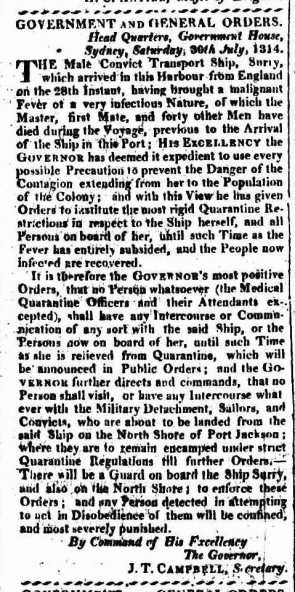
In early nineteenth century, however, all transport ships arriving in different colonies of the British empire, they were kept in rigid quarantine restrictions. In 1814, a Male convict transport ship Surryhad many female passengers suffering with malignant fever. Many of the crew had died during the long journey itself. A special medical quarantine officer was assigned the duty to ensure that no person had any physical / sexual contact with the females on board the ship.
Robert Koch observed that when tuberculosis became an epidemic in mid-nineteenth century it was blind to these earlier perceived social distinctions. It did not discriminate between rich and poor, good and bad, old and young, male and female, and attacked everyone. The disease was taking many lives. An infected person often had rapid weight loss and severe respiratory problems. The patient would also cough up coloured sputum.
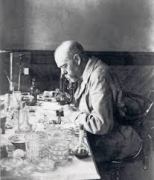
Koch conducted the autopsies, which always indicated to white granules in the cavities of the lungs. It was after this that tuberculosis acquired a new name ‘The White Plague’. So with his research the Germ theory originated around 1880. During the next two decades medical sciences reached its high point. The central role of germs in producing illness was demonstrated for the first time. It completely set aside the earlier misconceived ideas about the causes and nature of epidemics like cholera.
This was also the time when the Suez canal was constructed in 1869 that allowed faster and less time-taking ship movements between Europe and the Asian colonies of the British. Earlier, the ships had to take a much longer route. They had to take a full circle of Africa through the Cape of Good Hope to reach Indian ports. The new route reduced the cost of transportation of raw material from India. This in turn also affected the cost of production of the British goods in world market. Thus the rapidity and cost-effectivity of her sailing ships was a critical factor in allowing Britain to maintain her economic lead. As the canal reduced the journey time between Britain and India by almost 50 per cent, its military as well as commercial importance was huge.
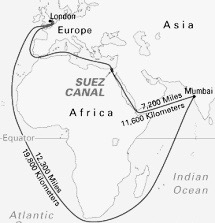
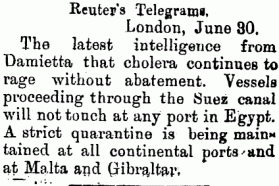
Around 1880, almost 80 per cent of the tonnage passing through the Suez Canal was of the British. In the decade of 80s there was an outbreak of cholera epidemic in Bengal. All the European countries put pressure on Britain to quarantine the crew and the labour coming on the British ships. Turkey also raised her concern because Jidda was an important ports in the Red Sea, and it was from here that many Muslim pilgrims went to Mecca. Quarantine stations on the north and south side of the Red Sea were constructed. They wereforced to undergo long periods of quarantine on the ship itself near the Suez canal before disembarking. Now, the quarantine process began to cost Britain both in terms of time and money.
In 1882, Egypt was made a protectorate of the British Empire. An immediate repercussion of this was that Egypt was also hit by cholera epidemic. The British government was in a very tight spot, as many European countries reiterated the issue of disease spread from colonial India. Britain was not ready to accept the idea that cholera was a communicable disease. She had always claimed that cholera has more to do with unhygienic condition. She ruled out Robert Koch’s theory that Cholera was caused by bacillus germ.
Britain appointed a government panel of medical experts under Dr Guyer Hunterto send message to the outside world that she is serious about disease epidemiology. But interestingly, she was careful not to include any such doctor on the panel who was sympathetic to Koch’s germ theory of cholera. It was deliberately avoided to keep an expert in microscopy in the team. Therefore, when investigations on cholera patients were done in Egypt, microscopical studies of water supplies were not done. The panel did not make any attempt to isolate specific microbes either. The British doctors concluded that the epidemic was caused by unusual weather patterns. Such a conclusion was to suggest that cholera germs had been dormant in the Egyptian soil since the last outbreak in 1865. So the recent cholera outbreak in Egypt, according to them, was because of the germ getting active again, and not because of the contagion from India coming on British ships.
On diplomatic front, Britain was successful in negotiating with France that all ships coming from India to the Red Sea would be put for sanitary inspection at Aden port. She promised that the infected person found on board the ship would be disembarked immediately.
Robert Koch was not convinced at all. He himself arrived in Calcutta and tried to investigate his postulation that there was some microbial culprit behind the disease. His anatomical studies proved that cholera is an intestinal disease. There were distinctive microbes in the intestine in the form of a comma-shaped bacillus. It was in the mucus lining of the intestinal tract. While Koch was busy investigating to develop a vaccine, the epidemic death curve flattened. Robert Koch then had to return back to Germany empty handed.
It took many more years to develop a vaccine for Cholera because of this British concealment of facts of the disease. After many years, Waldemar Haffkine, a Russian-born scientist, was able to develop a vaccine based on Koch’s early research on Cholera. He came to India in 1893 with the support of the former viceroy of India Lord Dufferin. In Calcutta, he was able to vaccinate 116 of the 200 residents of a locality where cholera had spread, and all of them escaped the epidemic. The unvaccinated people died. In Assam too his vaccine had a huge success.
The germ theory established that microbes cause illnesses within the body, which spreads from one person to another. It also suggested that same microbe always produce the same disease in susceptible hosts. These early researches are still so relevant when coronavirus has come as pandemic, and virologists are working on developing a vaccine for it. It is essential, however, that initial history and epidemiological information of coronavirus is shared honestly with the world.
[Total words: 1400]
 Speaking History
Leave a comment