

 Migrate to Survive the Pandemic Times
Vipul Singh
The daily wagers are not ready to join the chorus with the urban middle class. Migration to them is a way to survive the difficult times of pandemic.
Why this sudden bewilderment, this confusion?
Why are the streets and squares emptying so rapidly,
everyone going home lost in thought?
Because night has fallen and the barbarians haven’t come.
And some of our men just in from the border say
there are no barbarians any longer.
Now what’s going to happen to us without barbarians?
Those people were a kind of solution.
(Source: C.P. Cavafy: Collected Poems (Princeton University Press, 1975)
The huge popularity of the Prime Minister of India has been proven yet again. He goes live at 8 pm on TV and requests the citizens of India to clap for five minutes at 5 pm as a tribute to the selfless and unsung heroes- our doctors, medical staff and police. People respond to his call with much vigour and emotions. Every house and apartment’s balconies are thronged with people clanging dishes, ringing bells and clapping. Many people made Shankh-naad (sound of conch shell) for cleansing negative energy. And then comes another appearance of the PM. He issues a statement to the nation for a total lockdown. The expression of indispensability of such step in the midst of struggling economy could be seen on his face as he urges the citizens for the dire need for social distancing during the difficult times of pandemic Covid-19. He cited the health experts’ advice and confessed the limitations of the medical facilities of India as compared to the developed world. He was genuine and meaningful. Two days later Delhi government comes up with relief package and beginning of soup kitchen for the poor. A sum of Rs.1.7 lakh crore relief package is announced with the aim to prove a safety net for the poor. It was also declared that 800 million people will get free cereals, cooking gas and cash for three months through direct transfers. The main opposition party comes with praise of the Central government to announce relief package for the poor. Undoubtedly, these are much needed measures.
Social distancing has been the buzzword to face up to the novel virus contagion. The educated middle class is upbeat to support the regulation of the state. It is the poor working people, however, who are not happy with the expedient adopted for the purpose. They have been hit hard by social and physical distancing. There is a huge population of largely migrant rural poor from Bihar, eastern Uttar Pradesh, Madhya Pradesh, Chhattisgarh and Rajasthan who work in Delhi and National Capital Region as daily wagers, masons, rickshaw pullers and street vendors. They live in difficult conditions in shanties with bare minimum facilities. They are dependent on their daily petty earnings, which has come to a complete halt. The rich and middle class have stopped their entry into their houses and apartments because of the notion that they live in unhygienic conditions. The urban middle class is happy sharing their photographs of doing their domestic works personally on social media.
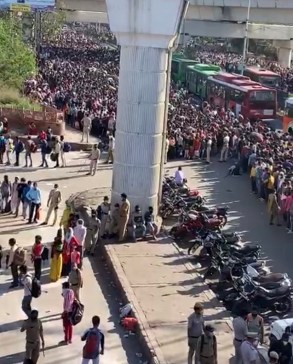
Left with little hope in an atmosphere of uncertainty the poor have decided to migrate. Their beeline on Delhi-UP border is being represented as uncultured and barbaric. This is coming from the misconception that the more unhygienically you live, the less civilized you are. Those living in the juggies (shanties) are considered the most backward and uncivilized; those living in apartments are slightly more elevated economically and culturally; and those living in kothis (bungalows), the rich, that includes the political leaders, corporates, and film stars, are more advanced and civilised.
For the huge number of daily wage workers, lockdown and social distancing is the curtailment of their liberties. They are crossing over from Delhi to Uttar Pradesh. They are desperate to return to their far-off villages even if it requires covering some hundreds of kilometers by walking. Many of them are bachelors, but a large chunk among them can be seen with their small children and wife. They are carrying bags and other belongings that they could manage bundle up after impulse decision to go back. James Scott has written of a similar situation about Zomia community of south-east Asia in The Art of Not Being Governed. They were ‘understood as runaway, fugitive, maroon’. Instead, they were ‘fleeing the oppression of state-making projects’ such as epidemics among other things.
The working poor of Delhi and NCR see the measures taken by the state unsuitable to their way of life. Their social life lies in meeting up their brethren from villages in the weekly bazaar (markets) and conversing with each other in their vernacular dialect with open heart. Their world lies in the cluster of shanties with tea stalls to chat, where no body is there to question the way they live. They are left with nothing to eat in their shanties. And when they go out searching to buy some foodstuff, they are beaten up by the police.
Now that the state has tried to discipline them with a set of behavioural rules and circumstances, they have resisted passively. They have decided to go back to their villages. It is a design, which is deliberate and a way to keep the state at bay. They are also migrating because of the fact that many of them have their bank accounts in their villages, where the cash transfer from the government would come.
State always thrives in the times of pandemic. It happened after cholera epidemic of the seventeenth century Naples, cholera and smallpox epidemic of 1770 in Bengal, and after 1918 Spanish flu in India and and other countries. Citizens were so frightened that they were ready to listen to any pronouncement. Today urban middle class in particular is even ready to surrender its rights of life, and may be even deaths. But the daily wagers don’t just listen to the state. They know how not to be governed even when they are in deep crisis and are left with hardly anything to eat. They are not ready to join the chorus with the urban middle class. They have preferred to migrate. Migration to them is a way to survive the difficult times of pandemic.
[Total words: 1010]
 Speaking History
Leave a comment