


UNIFIED WORLD OF EPIDEMICS: A RELOOK
Vipul Singh
The contagion has unified the world yet again. Unlike the earlier epidemics in which sea and road travels were responsible for the disease transmission, the air travel has played a key role in COVID-19 becoming a pandemic.
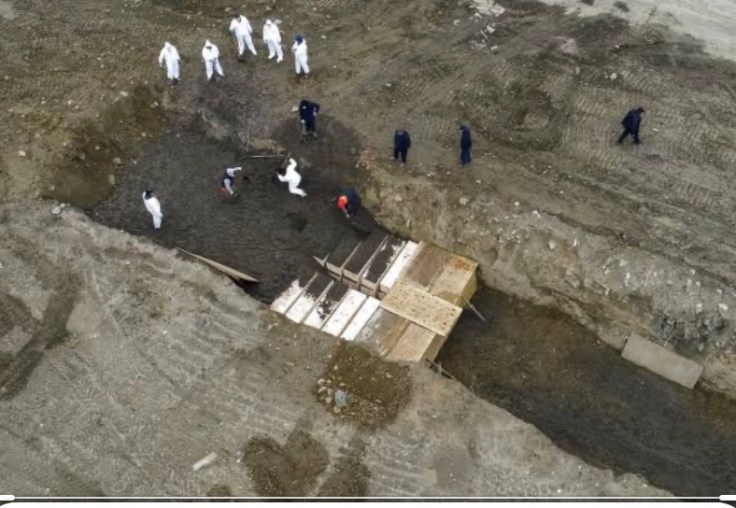
Images speak louder than words. Almost all the newspapers published the photograph of a mass grave dug up in New York, and health workers, wearing protective gears, masks and glass shields lower down the caskets. In a 1656 painting of Naples of Plague year, we see the depiction of a similar situation as the piled up dead bodies lie on the streets. The painting also shows that the slaves are wearing masks to avoid smell while carrying away the dead bodies.
Naples was one of the largest city in Europe in the seventeenth century. It lost more than half of its population due to the spread of plague.[1] Plague was transmitted to different parts of Europe along trade routes and through the movement of troops. Before this, there was another major outbreak of plague in the fourteenth century which led to the death of huge European population. For instance, France had a population of 17 million in 1320 which dropped down drastically to 9 million in 1440.[2] The disease took an epidemic form not only because of the trading contacts but also because of the soldiers. War soldiers were the means of transmission as they carried ‘typhus-infected lice or plague-bearing fleas’. LeRoy Ladurie writes-
‘The doom-laden regions of Central Asia, infested with rats and plague-bearing fleas, were being crossed early in the fourteenth century by the silk caravans and by the wide ranging Mongol armies, who were free to roam where they would, thanks to the political and commercial pacification of the heart of the old continent, brutally achieved by Genghis Khan and his followers. The increased travels of germ-carriers created a sort of common market of viruses and other bacilli, first in Eurasia and later on both sides of the Atlantic…Germs were thus able to take short cuts that would have been quite impossible before 1300, causing most notably the outbreak of the Black Death in 1348, the sequels of which were to cause havoc in France, until the last recorded epidemic of plague in Marseilles in 1720′.[3]
Wars during those years were thus indirectly responsible for the depopulation. But it does not mean the balancing of the population through ‘Malthusian check’, according to LeRoy Ladurie. The reasons were more complex. The very idea of a ‘modern state’ with thoroughly ambitious absolutists monarchy featured with bureaucracies played a significant part in the economic decline during the early modern centuries. It was so because more than half of its budget was swallowed up by the army and military institutions. Wars in that sense during these years acted as ‘predators’ as they caused deaths and led to heavy taxation, leading to crisis. LeRoy Ladurie argues that ‘alongside the paroxysms of war’ the other major factor was the epidemics which came during the long peacetime years. When droughts struck during these years of peace it became more disastrous, because there was shortage of food amongst the poor. The famine like situation was experienced making the people vulnerable to epidemics. It provided a favourable breeding-ground for the plague because of the malnutrition of the people, leading to the death of a huge European population in the fourteenth century. Thus, spread of epidemic plague led to the unification of the European.
The unification of the world by disease happened during the very last years of the fifteenth century and the early decades of the sixteenth century when epidemic disease spread to the ‘new world’, across the Atlantic Ocean. Le Roy Ladurie cites the case study of Mexico by Woodrow Borah. Borah believed that the main reason for the demographic decline of the American Indians was the spread of epidemics. The Spanish conquerors were immune to many of the diseases which had been quite common in Europe. But the native population of Mexico, the West Indies, North and South America were suddenly exposed to the pathogens, and diseases like measles, smallpox, influenza, typhus and plague etc. These diseases proved to be coup de grace to the native population of these new world countries. The first region to be affected by the disease shock was Hispaniola in the Caribbean islands. It had a native population of some 7 to 8 millions at the time when Christopher Columbus touched the island, which came down drastically to 250 people in 1540. Similar genocide by disease was also experienced in the Pacific with areas of Australia, New Zealand, Hawaii lost much of its aboriginal population during the eighteenth and nineteenth centuries after the European contacts. While Australia with 300,000 aboriginal population before 1780 came down to 80,000 in 1937; New Zealand’s 300,000 to 40,000 in 1900; and Hawaii’s 400,000 native population in 1778 declined to 40,000 in 1900.
The transmission of diseases crossing different national boundaries became common after Christopher Columbus discovered America and the ‘New World’ came in contact with the ‘Old World’. Some 250,000 Spaniards travelled to the New World in the 1500s, and another 450,000 made the journey in the 1600s. After this there was an inadvertent exchange of diseases, plants, and species among many things. While the aboriginal population of American land was exposed to diseases such as smallpox, cholera leading to their massive death, what Le Roy Ladurie calls ‘unparalleled genocide’ and which was ‘more devastating than any outbreak of plague in Europe’.The Europeans also brought with them the disease syphilis, which Alfred Crosby believes was not there in the old world before the sixteenth century.[4] Christopher Columbus had obtained a royal patent and financing from Isabella and Ferdinand of Spain that authorised him to explore, discover, and claim for Spain new territories surrounding the Atlantic. Columbus followed the migratory birds and reached an island in the Atlantic Ocean. His three-ship fleet sailed from Spain on September 8, 1492. By picking up the trade winds he made landfall in the Bahamas thirty- three days later on Oct 12. Columbus touched an island in the Caribbean on 12 October 1492. His landfall established a new maritime connection between Old and New Worlds. In other words, two hemispheres, Eastern and Western Hemispheres came in contact with each other for the first time. After this event the interaction between humans and nature throughout the world became a permanent feature, and rather became more and more easy with advances in transportation technologies. The microbial and biological exchanges began to take place more frequently, and that has continues till today. The Europeans with advances in shipping aggressively explored new territories. They had modern weapons that allowed them to triumph over the native population. They exploited newly discovered territories for natural resources by settling colonies. They cleared forests, introduced old world sedentary cultivation. The Europeans also introduced new flora and fauna.
The first group of islands discovered by Christopher Columbus was that of the West Indies. After visiting several islands of the West Indies Columbus landed on the northern coast of Hispaniola and established a small encampment at Navidad. The West Indies was a chain of islands in the Caribbean Sea, which included, the Greater Antilles, including Cuba, Puerto Rico, Hispaniola, and Jamaica; the Bahamas; and the clusters of smaller islands in the Lesser Antilles. It was a tropical region with warm and humid climate. Steady north-eastern trade winds blew across the islands year-round that helped in the sailing of ships. The islands were full of vegetation with tropical rain forest, and a variety of tropical trees. When Columbus and his crew reached the Navidad they realised that the natives were not a military threat as they lacked even iron and steel weapons. One thing that attracted them most was beaten gold ornaments that the aboriginals wore. It convinced Columbus that they not had knowledge working on gold but mines of gold existed in the islands. Columbus and his men were successful in taking out from the Indigenous peoples the sources of the gold. One of his captains discovered gold placer mines in the hills named Cordillera Central. After few months, Columbus decided to return to Spain with huge cargo of gold. He also enslaved Taino men, women, and children and some Taino crops like maize. He asked thirty nine members of his crew to remain at Navidad. In January 1493, Columbus loaded the ships with gold and other items and sailed for home. He reached Spain on March 15. The gifts that he had carried for Ferdinand convinced the king that the revisit to the Caribbean by Columbus could be very fruitful. So within six months he asked Columbus to set out from Spain with 17 ships and fifteen hundred male colonists. They were a mixed group of people that included soldiers, administrators and artisans among others. These hundreds of people carried wheat, chickpea, and other seeds like fruit trees, grapevines, and animals like sheep, goats, swine, cattle, horses and dogs. Columbus was given the authority to grant individual property rights in land to the colonists in Hispaniola. The right to land was to be given on the condition that they would cultivate the land for at least four years and build a house.
When Columbus reached Navidad in November 1493, he was in for a shock. He found that none of the Spaniards left behind had survived. They were dead mainly because of the exposure to syphilis, a disease that the Europeans were never exposed to earlier and so were not immune to it. But a much graeter genocide was done by the disease that the Spaniards carried with them. Between 1492 and 1542 the Tainos aboriginals of Hispaniola became nearly extinct. The deadliest killer was the smallpox which was absolutely new to them. The Taino population was roughly 60,000 in 1508 that dropped to 18,000 in 1518, and very soon they were on the verge of extinction. The other common diseases transmitted to the new world were Smallpox, measles, diphtheria, whooping cough, chicken pox, bubonic plague, scarlet fever, and influenza. Nearly all of the European diseases were communicable by air and touch. During those years nobody knew how these diseases got transmitted from one human to the other, and illness in Europe was generally considered to be the consequence of some sin. So when the natives started dying in huge number, they were seen as non-Christian, and thus sinners. Gradually, the population of North America decreased dramatically as almost ninety percent of native Americans died due to some infection.
The year 2019-20 has been hit by another pandemic. It is mainly the modern cities which are mainly threatened by Covid-19. There are two reasons for this- the big cities are connected to the world through aeroplanes; and secondly, the population density is very huge. In the seventeenth century too, the big cities became ‘cities of death’ and the epidemics operated as ‘safety valves for the boom in population’ of the cities. Similarly, in the sixteenth century, connection of the New World with Europe through sailing were often the vehicle for the spread of disease. One of the reasons which played a significant role in the immunity of the Europeans during those years was their exposure to variety of animals and plants, and most of the pathogens originate with animals or insects. Domesticated animals and plants were more numerous in Europe, and this greater diversity meant more ecological protection.
COVID-19 has originated as a new virus which has jumped from animals to human cells for the first time in China. Humans have never been exposed to it before and that is why it has led to such rapid spread. China is one of the most connected countries, and so are the United States, England, Germany, Italy and Spain. These are the countries which are witnessing highest number of people infected with the Corona virus. It has gradually spread across different nations and is leading to the death of many humans because of its novelty to the human body. The contagion has unified the world yet again. But unlike the earlier epidemics in which sea and road travels were responsible for the disease transmission, the air travel has played a key role in COVID-19 becoming a pandemic.
[1] Silvia Scasciamacchia et.al. ‘Plague Epidemic in the Kingdom of Naples, 1656–1658’, Emerging Infectious Diseases. 18/1: 2012, 186–188.
[2] Emmanuel LeRoy Ladurie, The Mind and Method of the Historian,Chicago: Chicago University Press, 1981, p.13.
[3] Emmanuel LeRoy Ladurie, The Mind and Method of the Historian, p.12.
[4] Alfred W. Crosby, ‘Conquistador y Pestilencia: The First New World Pandemic and the Fall of the Great Indian Empires’, The Hispanic American Historical Review, 47/ 3: 1967, pp. 321-337.
Photo Source: Source: https://en.wikipedia.org
[Total words: 2065]
 Speaking History
Leave a comment