

Book Review
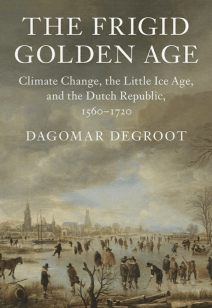
Dagomar Degroot , The Frigid Golden Age: Climate Change, the Little Ice Age, and the Dutch Republic, 1660-1720, New York: Cambridge University Press, 2018. Pp.xxii, 364.
During the last two decades there has been a deluge of research on environmental history that use traditional historical sources and records along with studies of changes in climate, water, forest, disease etc. Among such nature aspect studies, research on climate histories have largely been dominated by earth and climate scientists. One such scientist, who culled numerous information from historical accounts to prove that seventeenth century (between 1645-1715) was a period of Little Ice Age, is John Allen Eddy. He popularized the name of this period as “Maunder Minimum”. Eddy corroborated these 70 years period with minimum sunspots after a thorough analysis of all available records of solar activity, including records of sunspot observations by astronomers and carbon-14 record of tree rings. During this coldest phase of the Little Ice Age there are indications that average winter temperatures in Europe and North America were 2°C lower than at present. The entire Northern Hemisphere, particularly Europe, experienced winters of extreme severity and summers were often cool and wet. One of the first historian to enter into the Little Ice Age debate is Jan de Vries. In 1978 he suggested that the chilly and erratic climate of the Little Ice Age did not spell disaster for the Dutch economy (Jan de Vries, ‘ The Economic Crisis of the Seventeenth Century after Fifty Years’. Journal of Interdisciplinary History 40:2( 2009 ):164). Two and half decade later historian Geoffrey Parker blamed seventeenth century cooling for the catastrophes around the world (Geoffrey Parker, Global Crisis: War, Climate Change and Catastrophe in the Seventeenth Century, New Haven and London: Yale University Press, 2013).He argued that the cooler conditions led to widespread crop failure, famine, and population decline. There were increased levels of wars and social unrest as large portions of the population were reduced to starvation and poverty. The Frigid Golden Age is a fabulous addition to the study of climate history. The author of the book Dagomar Degroot is against such sweeping generalisations and thinks that the socio-economic relationships with Little Ice Age were far more complex.
Dagomar Degroot has shown how by using scientific studies of the past centuries along with conventional historical sources, what Donald Worster calls speaking the ‘most outlandish language’ of ‘natural scientist’s’, one can get a completely new insight (Donald Worster, ‘Doing Environmental History’ (Appendix), The Ends of the Earth: Perspectives on Modern Environmental History, Donald Worster and Alfred W. Crosby eds., Cambridge: Cambridge University Press, 1988). Like many of the writings on the subject of environmental history, the author rejects the conventional assumption of anthropocentricism. He argues that human history is not exempt from natural constraint, and phenomena like climate changes can have ‘very unequal consequences for different societies’. It can harm not only societies that have few resources to exploit , but also those that require abundant resources to prosper. In that vein, he presents the Dutch Republic as an exceptional case which thrived in the seventeenth century not because it was rich, but ‘because much of its wealth derived from activities that climate change either benefitted or affected ambiguously’(p.308). The author acknowledges that the Little Ice Age entered the mainstream of the historical profession owing to the pioneering work of scholars such Emmanuel Le Roy Ladurie, Hubert Lamb, and Christian Pfister, who were the first develop rigorous methods for reconstructing past climate changes and tied them to human histories. He although does not categorically mention that the Annales school historians, specially Fernand Braudel, have been drawing attention to the environmental basis of society for many decades. Dagomar Degroot also sees why it is only in recent years that climatic factor is being reorganized as an important influence in the course of human history. In 1970s the Annales historian Emmanual Le Roy Ladurie although hesitated to link climate with history, but that could be due to his dependence on limited data of dendrochronology in geographical terms (Emmanual Le Roy Ladurie, Times of Feast, Times of Famine: A History of Climate since the Year 1000, Garden City, N.J.: Doubleday, 1971, p.120). Dagomar Degroot is against any sort of environmental determinism as such, and sees relationships between climate change and human activity as ‘complex and counterintuitive’ (p.8) as he probes the connection between climate change and human history through geographically wider data.
Dagomar Degroot use of sources makes the book very unique both in terms of information and analysis. He is surprised that despite much of the material such as sailing ships’ logs been around for centuries, yet historians have not used such sources to write the history of the seventeenth century. He says that these logs include data on tides and winds, on ocean currents, climate and weather. Dagomar Degroot takes forward the hypothesis of Little Ice Age by reaching fresh conclusions with use of the newest scientific scholarship and diverse textual sources, such as letters, intelligence reports, diary entries, and logs, which show how weather affected people. These sources are very significant because people whose lives and livelihoods depended on the weather wrote most of these documents. The author has a point on his dependence on logs so much. It is because few relied on weather more than sailors.
The book is a brilliant analysis of Little Ice Age and its impact on the Dutch Republic. The author suggests that part of the Dutch success story was the republic’s resilience in the face of climate changes that contributed to disaster elsewhere in Europe. He shows that the Dutch republic’s prosperity and power in the seventeenth century was because of its ability to avoid those disasters. The author covers the entire cold period in the northern hemisphere between 1560 and 1720, which had rather two frigid climatic regimes – the Grindelwald Fluctuation (1560–1628) and the Maunder Minimum (1645–1720). Dagomar Degroot demonstrates that weather shaped the history of the Dutch Golden Age. He says that the weather trends in the chilliest phases of the Little Ice Age had ‘beneficial consequences for distinctively Dutch ways of conducting commerce and waging war’ (p.5). Climate changes certainly presented challenges for Dutch citizens, but it also opened opportunities for merchants, sailors, soldiers, and inventors. In fact, unlike other European countries the Dutch did not rely on domestic agricultural production for its prosperity. While examining the Dutch Republic’s prosperity, the book highlights the complex relationships between global climatic trends and local environments. It shows how changing climate influenced the transportation networks that helped in sustaining the Dutch trading empire. Weather in cooler climates quickened the journeys of departing ships. The author also tells us that the changed climate had not acted in favour of the Dutch always. In the 1630s and 1650s, the weather rather impeded the Dutch offensives in the Spanish Netherlands and foiled the republic’s naval operations during the First Anglo-Dutch War. The Little Ice Age also affected land reclamation, agricultural production, pastoralism, and industry within the Dutch Republic. It helped cause catastrophic storm and river flooding. But all these also encouraged social spaces and technologies that contributed to the ‘resilience’ and choices environmental circumstances allow them to make (p.6). Thus, One of the book’s most important principles is that even slight changes in environmental conditions can have disproportionate consequences for the societies.
The author is well aware of the limitations of climate histories. He says that it is very hard to clearly link climate changes through historical records. He shows how it is difficult to connect climatic trends to human activities on small and local scales (p.14). To that end historians work with relatively limited sources. On the other hand, scientists can establish these relationships by using ‘big data’ that help them interpret meteorological data collected by thousands of weather stations all around the world. Dagomar Degroot also views that climate historians have to confront with ‘probability’ as well as most historical narratives deal in probability, and also because historians can rarely establish all the little connections that together link historical trends and events. Since the trends are very vast in climate history writing, so connecting them to distinct events on a human scale becomes very testing for historians. Historians have another challenge while they write climate history. They may get into the trap of simplistic determinism – the idea that a set of forces predetermined the course of human history. Dagomar Degroot argues that it is because of the probabilistic nature of climate history that scholars in the twentieth century repeatedly made sweeping assumptions about relationships between climate changes and human history on century timescales that provoked deep and enduring scepticism among mainstream historians. So the author is optimistic of the fact that just as historians have started making more and more use of scientific climate reconstructions data and methods for deciphering weather information in old documents, it has allowed them to track the consequences of climate change at the local level with more certainty. He advocates that historians can build on the scientific reconstructions done by natural scientists and tie them to human history in ways that enrich our understanding of the future .
Divided into seven chapters, the book although mainly revolves around the Dutch Republic social and economic transformations in the changed climate, it often hints at the way other early modern powerful states of the world negotiated the changes. The Mughal Empire in India, the Tokugawa in Japan and the Ming and Qing dynasties in China responded to monsoon failures and catastrophic famine differently. A separate chapter on global scenario would have made this book all the more interesting.
Overall the book is outstanding in the presentation of paleoclimate evidences along with much unused logs of sailing ships to give a new perspective to the seventeenth century. It shows the way historians, social scientists, and natural scientists could come together to write interesting environmental histories of the past centuries.
(Total Words: 1650).
 Speaking History
Leave a comment