

In a city such as Delhi, where there is a wide gap between the rich and the poor, poverty is glaring, and so is income inequality, a long-term policy of pollution control should be worked out. It should be based on beneficiary-pays principle. Taxpayers could be asked to pay extra environment conservation cess from the car owners and from those living in kothis. But the big question. Is the government brave enough to take such bold steps in a politically charged environment?

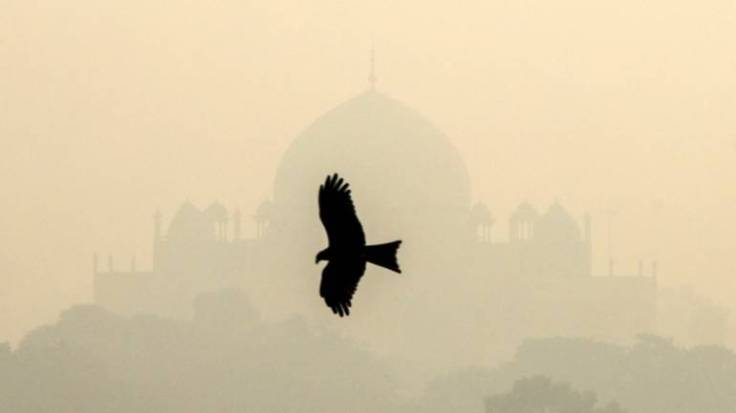
Photo: Humayun’s Tomb on a clean morning and on a smoggy morning
The recent Greenpeace report has ranked Delhi as the most polluted capital in the world, while its satellite township Gurugram has bee ranked the most polluted city. The ranking is no surprise to the residents as they have are not able to breathe easily. The Delhi CM in November 2017 had tweeted – “Delhi has become a gas chamber. Every year this happens during this part of the year. We have to find a soln to crop burning in adjoining states”.
To that effect, Delhi government over the recent years have come up with many experiments such as the introduction of the odd-even system for private cars, the sprinkling of water on trees and installation of air cleaners in the crowded areas. But these measures have not been effective enough.
In the ancient past, Delhi was not a very well known city. Its fate as the capital city changed during the early medieval period when the Turkic invaders made it their capital. It was strategically suitable to them, as they needed a bastion to control Punjab and Sindh and generate revenue from the Gangetic plain. Later, the Mughals too considered important, along with Agra, as a convenient watchtower for the northwest and as a gateway to the Deccan. When the British first came to India they preferred to make Calcutta as their capital. But when their empire expanded to all over India it became difficult for them to control the entire Indian territory from Calcutta. So they announced Delhi as the capital city in 1912. Since then it has grown both in size and demeanor. The last three decades have seen a massive migration of people to the capital.
Delhi continues to grow demographically because of the huge employment potential in the region. A relatively very slow pace of economic progress in far off provinces of Rajasthan, Bihar, Bengal, Orissa, Chattisgarh, Jharkhand, and Madhya Pradesh has worked as the push factor for the massive migration in Delhi. The state does not intend to leave any stone unturned for the city’s development, despite many obstacles and limitations, like huge migration from outside and the resultant over-population. It is making all-out effort to nurture it as the world-class city with the cooperation of the people. It has been able to shut down or shift the polluting industries. Vehicular pollution has been reduced with the increasing use of CNG and the introduction of Metro railways as public transport. But there are certain problems at the core, which the government needs to look upon more seriously.
In a city such as Delhi, where there is a wide gap between the rich and the poor, poverty is glaring, and so is income inequality, a long-term policy of pollution control should be worked out. It should be based on beneficiary-pays principle. Till now the government’s policy has largely been based on the polluter-pays principle, which means that those who pollute or are responsible for pollution are liable to be penalized for the act. For instance, odd-even system and the system of penalizing those who pollute or have not got their pollution certificate done are based on polluter-pays principle, and thus the polluters are liable for the damage to the environment.
The beneficiary-pays principle states the opposite. It says that if slum dwellers are polluting the streets for the early morning toilet, it is not the slum dwellers but the people living in big houses in the locality who should arrange for the construction of movable toilet vans. The clean city will ultimately benefit the people living in kothis (houses), and therefore, they should pay for the cost of clean streets. In the developing country like India, where poverty and income inequality is glaring, this payment method of pollution control or the beneficiary-pays principle may be the most viable alternative.
We have seen that over the years the poor commuters using public buses and metro have been forced to pay a higher fare in order to finance cleaner and smoke-free bus so that everyone can enjoy cleaner air. Delhi needs cleaner buses, which could be financed by all the city residents, and not just the bus commuters since everyone will benefit from the clean air. So, instead of keeping high fares for the newly introduced low-floor buses or the Metro railways, the state should make efforts to reduce the burden on the poor. This would allow them to spend less on their travel and use their money for the purchase of environmentally friendlier products, which are costlier. The loss so incurred to the state could be met from the tax burden on the richer section of society. To be specific, the taxpayers could be asked to pay extra environment conservation cess from the car owners and from those living in kothis. But the big question. Is the government brave enough to take such bold steps in a politically charged environment?
 Speaking History
What an emphatic piece!
LikeLiked by 1 person