

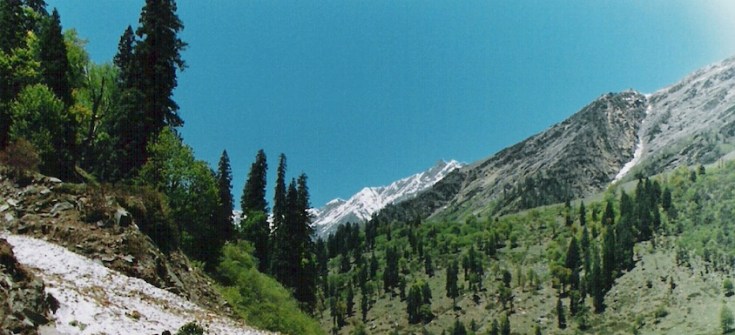
While climbing up the Gangotri hill I was surprised to see the size of the trees getting smaller and thinner, and they looked younger from the diameter of the trunks. It is an indicator of climate change. Earlier the very cold temperature did not allow any tree to grow, but over the last two decades the temperature increased and the new climatic condition allowed the trees to grow even on this greater height.
In 2007, in its fourth assessment report, the Intergovernmental Panel for Climate Change (IPCC) had claimed that the Himalayan glaciers could melt away by 2035.
Gangotri Glacier is the longest glacier in the Central Himalayas. It is almost 29 km long and two to six km wide as per one estimate. The satellite pictures give a look of a gigantic highway through the heart of the mountains. Gangotri glacier has been receding at the rate of 10-30 meters per year over the second half of the twentieth century (Gyan Marwah, “Ganges – A River of No Return?” The South Asian, 2004). While the rate of retreat was nominal between 1935 and 1956, it started to increase rapidly after that. In terms of the total area, the retreat was 2,530 sq. m. between 1935 and 1956. It increased by around two and a half times between 1956 and 1962 and five times from 1962 to 1971. But in the last 20 years, the glacial channel feeding the Ganges river has shifted many meters away and has now changed the track. This has also led to the shrinking of the volume of water discharged.
Gomukh is 18 km. from Gangotri located at a height of 4255 m. It could be called the trunk of the Gangotri Glacier. Here Bhagirathi river flows at a very brisk pace. Around Gomukh, nature presents a natural topography. I could see huge boulders of rocks with some pieces of broken snow, along with the hard clayey snow of the glacier. The topmost part of the Gangotri hills was dry land, with little evidence of trees around. But in between Gangotri and Gomukh was a place called Chirbasa, which is the abode of Chir trees. So, if one looks down the hills from Gomukh, there is a stark contrast – the green jungles after a dry land. Down the slope, the dry land ends abruptly at a stunted forest. I requested my local guide to let me do some tracking, off the normal route where the forest seemed to get thinner and thinner. While climbing up I was surprised to see the trunks of dead trees lying there. And to my utter surprise, the size of the trees up the hills was getting smaller and smaller, and looked younger from the diameter of the trunks. The tourist guide, who belonged to one of the remote villages in the region, told me that the trunks that we saw lying around were cut illegally. One of the most startling information that he gave me was the expansion of forests, although the density of trees was getting thinner over the last two decades or so. Was the forest expanding? If really so, I got tempted to know why? There must have been some change in climatic condition to allow the trees to grow on greater height. As I pondered over the piece of information given to me, I remembered reading quite often in the newspapers and journals that the Gangotri glaciers were melting. I wondered if the temperature on Gangotri hills had become warm to permit trees to grow where previously only grasses could take root. It was the first evidence I saw that might affect earth during my lifetime. It left me troubled and uncomfortable throughout that night when I came back to the hotel. This was certainly the impact of global warming and climate change.
 Speaking History
Leave a comment